
DTI Restrictions vs. LVR Easing: Which Change Actually Impacts Your Borrowing Power?
- Joshua Flack
- May 15
- 4 min read

Updated: Jul 15
TL;DR
The Reserve Bank eased LVR settings in December 2025. It also has DTI restrictions baked into the system since July 2024. Most investors hear "rules eased" and assume borrowing capacity went up. It didn't, not in any meaningful way. LVR controls the deposit you need to get in the door. DTI controls how much you can actually borrow against your income. They work together, and DTI is now the tighter ceiling. If your income doesn't scale, no LVR change will save you. This post explains the real interaction and where most investors miscalculate.
Most coverage of the December 2025 LVR easing read like a green light.
It wasn't.
The Reserve Bank loosened one rule and left the other in place. Investors who only read the headline assumed they had more room. The numbers tell a different story.
What Actually Changed in December 2025
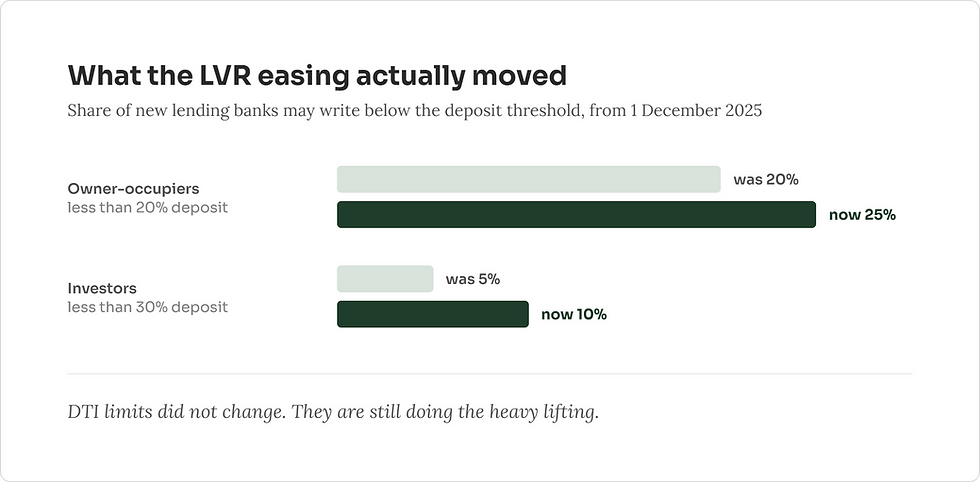
From 1 December 2025, banks can write up to 25% of new owner-occupier lending to borrowers with less than a 20% deposit, up from 20%. Investors got a smaller adjustment: up to 10% of new investor lending can now go to borrowers with less than a 30% deposit, up from 5%.
That's the easing.
It sounds significant. It isn't, for most active investors, because LVR was never the binding constraint at portfolio scale.
What Didn't Change
DTI rules are still in place and still doing the heavy lifting.
The thresholds:
Owner-occupiers: total debt above 6x gross income is "high DTI"
Investors: total debt above 7x gross income is "high DTI"
Banks can only write 20% of new lending above those thresholds. That's the speed limit. Most banks fill that bucket fast and use it carefully, so in practice you're either inside the line or you're competing for a scarce exception.

Which One Bites First?
This depends entirely on where you are in your investing journey.
For first-time investors with strong equity in their home: LVR matters more. You're solving for deposit, not income capacity. The 30% deposit ceiling is the gate.
For investors already holding one or more properties: DTI is the wall. Every new mortgage adds to total debt, and that figure compounds quickly. Income, on the other hand, scales linearly at best. The maths gets ugly past three properties unless household income is well above average.
Quick worked example. The household has:
Salary income $180,000
Two existing rentals at $550 and $520 per week
Existing debt $1.3m across own home and the two rentals
Looking at a $700,000 purchase with $600/week projected rent
For DTI, banks count salary in full and add rental income at 75%-80%. That 20%-25% haircut covers vacancy, management costs and yield assumptions.
DTI income:
Salary: $180,000
Existing rentals: ($28,600 + $27,040) × 75% = $41,730
New rental: $31,200 × 75% = $23,400
Total: $245,130
DTI debt:
Existing: $1.3m
New mortgage at 80% LVR: $560,000
Total: $1.86m
DTI ratio: $1.86m ÷ $245,130 = 7.6x
That's outside the 7x investor threshold even with rental income properly counted. The deposit doesn't matter if the DTI maths doesn't work. This investor either needs to lift income, drop the purchase price, or buy a new build (which is exempt from DTI).
The New Build Loophole That Actually Helps
New builds are exempt from DTI restrictions. That isn't widely understood.
If you're capped on DTI but want to keep buying, new construction is currently the only mainstream path. The Reserve Bank built the exemption to keep credit flowing into supply rather than restricting it. The banks have followed.
This is why so much new investor lending in 2026 is going into townhouses and new-build apartments, even where existing dwellings might offer better long-term capital growth potential. The financing rules are pushing investors toward what's lendable, not necessarily what's optimal.

The Practical Test
Two questions tell you which constraint you're solving:
After your next purchase, what's your total LVR across all property?
After your next purchase, what's your total debt as a multiple of gross income?
If question one breaks first, you have an LVR problem. If question two breaks first, you have an DTI problem.
Most investors moving past property number two are DTI problems, not LVR problems. The LVR easing helped first-home buyers and lower-leveraged buyers. It barely moved the needle for anyone scaling a portfolio.
What This Means for Your Next Move
If you're inside both rules, lending is straightforward and you should be acting before serviceability gets squeezed further.
If you're outside DTI, you've got three options:
Buy new builds and use the exemption
Increase gross household income (rental income at 75% counts in DTI)
Pause until income catches up to debt
If you're outside LVR, that's a deposit problem. Equity release from your home, gifting, or asset sale are the usual paths.
If you're outside both, you're not buying anything in 2026 without restructuring first.
Most investors don't know which rule is biting them. They just feel stuck.
At CRISP, we map your numbers against both rules before we look at property. You'll get a clear read on whether LVR or DTI is the binding constraint, and what specifically needs to shift before your next purchase is realistic.
Numbers first. Property second. No wasted applications.
Relevant tools and resources available for free here:
Other relevant articles to check out:
About the Author:
Joshua Flack is a mortgage and lending adviser and the founder of Crisp Financial. Before finance, he spent two decades running businesses across construction, facilities services, and franchising, which is why his advice starts with how the numbers actually work rather than how the brochure says they should. He works with home buyers, investors, and self-employed borrowers across New Zealand, with particular depth in complex and non-standard lending. Crisp Financial Limited (FSP1012114) operates under the Link Financial Group FAP licence. The information in this article is general in nature and is not regulated financial advice.
Comments