
How to Stress-Test Your Portfolio Against Rate Hikes
- Joshua Flack
- Jun 6
- 3 min read

TL;DR
Banks don't approve lending at today's rates. They test you at much higher rates to see if you survive a shock. You should run the same test on your own portfolio before the bank does, and before rates actually move. With the OCR expected to rise later in 2026, the gap between today's comfort and tomorrow's stress is exactly what a stress test reveals. This post shows you how to do it yourself.
The most useful number in your portfolio isn't your current interest rate. It's the rate at which your portfolio stops working. Banks know this number for you. They calculate it on every application using a test rate well above the actual rate. Most investors have never calculated it for themselves. That's a mistake, especially heading into a period where the OCR is expected to climb.
Why Stress-Testing Exists
Lending decisions can't be made on today's rate because today's rate won't last. Banks test serviceability at a buffer rate, commonly in the 8 to 8.5% range, to confirm a borrower can still pay if rates rise.
If you only survive at today's rate, you're not safe. You're exposed. The bank knows it, which is why they test high.
Do It Yourself: The Basic Test
Take your total lending. Calculate the repayments at three rates:
Your current rate
Two percentage points higher
A stress rate of around 8.5%
For each, work out the monthly cost and compare it to your income and rent.
Worked example. $1.5m of lending.
At 6%: roughly $90,000 a year in interest
At 7.5%: roughly $112,500
At 8.5%: roughly $127,500
That's a $37,500 annual swing from current rate to stress rate. The question is simple: at $127,500, do you still hold comfortably, or are you scraping?

What the Test Reveals
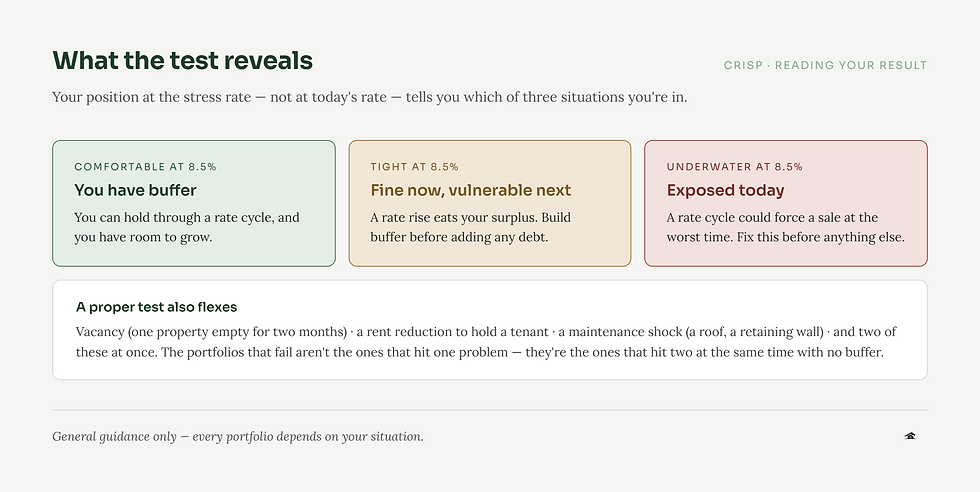
Comfortable at the stress rate: you have buffer. You can hold through a rate cycle and you have room to grow.
Tight at the stress rate: you're fine now but vulnerable. A rate rise eats your surplus. You shouldn't be adding debt.
Underwater at the stress rate: you're exposed today. A rate cycle could force a sale at the worst time. This needs fixing before anything else.
Beyond the Basic Test
A proper stress test also flexes:
Vacancy (what happens with one property empty for two months)
Rent reduction (what if you have to drop rent to hold a tenant)
A maintenance shock (a roof, a retaining wall)
Two of these at once
The portfolios that fail aren't the ones that hit one problem. They're the ones that hit two at the same time with no buffer.
Tools
There are calculators and modelling tools, including bank serviceability calculators and broker modelling software, that run these scenarios properly. The detail matters because the interactions, rate plus vacancy plus a fixed-rate roll-off, are where the real risk sits. A simple spreadsheet covers the basics. Proper modelling covers the combinations. Check out our calculator here.
Where This Leaves You
If you haven't stress-tested your portfolio at 8.5%, you don't actually know how safe you are. You know how it feels today, which is a different thing.
Run the test. If you're comfortable, keep moving. If you're tight, build buffer before you grow. If you're exposed, fix it now while you have options.
Stress-testing is the foundation of every lending conversation we have. It's the difference between a portfolio that grows and one that gets forced into a fire sale.

At CRISP, we model your portfolio against rate, vacancy and shock scenarios so you know exactly where your limits are. No surprises when the cycle turns.
Know the breaking point before you reach it.
Relevant tools and resources available for free here:
Other relevant articles to check out:
About the Author:
Joshua Flack is a mortgage and lending adviser and the founder of Crisp Financial. Before finance, he spent two decades running businesses across construction, facilities services, and franchising, which is why his advice starts with how the numbers actually work rather than how the brochure says they should. He works with home buyers, investors, and self-employed borrowers across New Zealand, with particular depth in complex and non-standard lending. Crisp Financial Limited (FSP1012114) operates under the Link Financial Group FAP licence. The information in this article is general in nature and is not regulated financial advice.


Comments