
Refinancing for Equity Release in 2026: How to Fund Your Deposit Without Saving a Cent

Updated: Jul 17
TL;DR - If you already own a home, your next deposit may already exist inside it. In 2026, many New Zealand homeowners are refinancing to unlock equity rather than saving cash. Rising property values and steady principal repayment mean usable equity is often substantial by your mid-30s onward. Lenders will typically allow borrowing up to 80% of your home’s value, with the difference available for reinvestment. The strategy works best for disciplined borrowers with stable income and a clear plan. It is not risk-free. Done properly, it accelerates portfolio growth without waiting years to save.

By your mid-30s to mid-50s, the game changes. Income is usually stronger. Debt is more structured. Most importantly, you have equity. That’s the lever.
Saving a traditional deposit for the next property can feel inefficient at this stage. You are sitting on a balance sheet that is already working. Refinancing to release equity is about using what you have, rather than starting again.
This is not a hack. It is a structured lending strategy used by experienced borrowers and understood by lenders. But it only works when the fundamentals are right.
Start with the concept.
Equity is the difference between your property’s value and what you owe. If your home is worth $1,000,000 and your mortgage is $600,000, you have $400,000 in equity. Lenders will not let you access all of it. Most will cap total borrowing at 80% loan-to-value ratio for owner-occupied property. In that example, 80% of $1,000,000 is $800,000. Subtract your existing $600,000 loan and you have $200,000 potentially available.
That $200,000 becomes your deposit.
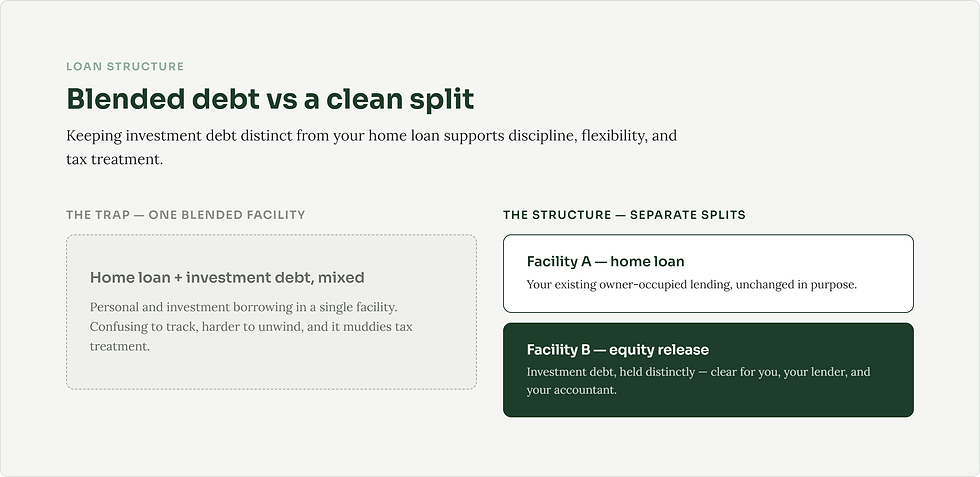
In practice, it is set up as a separate loan split. This matters. Clean structure keeps the investment debt distinct from your home loan, which helps with both discipline and tax treatment.

This approach has become more common post-2020, driven by two forces. First, property values rose materially, increasing available equity. Second, regulatory tightening has made saving large deposits slower, particularly with cost of living pressure. Data from Reserve Bank of New Zealand and lending commentary from ANZ Bank New Zealand and ASB Bank show a clear shift toward structured lending strategies rather than simple accumulation.
For the Crisp's clients, the question is not whether this is possible. It is whether it is appropriate.
There are three conditions that need to be true.
First, income must comfortably support the total debt. Not just today, but under stress. Lenders will test your ability to service at higher interest rates. This is non-negotiable. If the deal only works at current rates, it is fragile.

Second, your existing position needs to be stable. That means steady employment or business income, clean credit history, and no structural issues with your current property.
Third, there needs to be a reason to act. Equity release is a tool. It should serve a clear objective. Typically that is purchasing an investment property, consolidating and restructuring debt, or accelerating long-term wealth accumulation.
If those conditions are met, the mechanics are straightforward.
You obtain an updated valuation. This can be a full registered valuation or a bank estimate depending on the situation.
You work with a lender to restructure your lending. This usually involves splitting your mortgage into multiple facilities. One remains your home loan. The other becomes an equity release facility.
Funds are drawn and applied as a deposit on the next purchase.
From there, the second property is financed separately, often at a higher loan-to-value ratio, depending on whether it is owner-occupied or investment.
It sounds simple. The detail is where most people get it wrong.
The first mistake is overestimating usable equity. Market value is not the same as lending value. Banks take a conservative view. If you are working off optimistic assumptions, the numbers will not stack up.
The second is poor loan structure. Blending personal and investment debt into one facility creates confusion and limits flexibility. It also makes future decisions harder.
The third is ignoring risk concentration. If both properties are leveraged against each other, you are exposed to market movements and interest rate shifts. This is manageable, but it needs to be understood upfront.
Research from CoreLogic New Zealand shows that leveraged investors tend to outperform over the long term, but only when they maintain liquidity and avoid forced sales during downturns. That is the line you do not cross.
The advantage of this strategy is speed.
Saving a $150,000 to $200,000 deposit can take years, even at a high income. Equity release compresses that timeline into months. That changes the trajectory of your portfolio.
It also allows you to act when opportunities exist, rather than when your savings catch up. For many in the Crisp demographic, this is the difference between owning one property and building a portfolio.

But speed cuts both ways.
You are increasing leverage. That amplifies both gains and losses. If property values soften or interest rates rise materially, your position tightens.
The lending environment in 2026 reflects this balance. The Reserve Bank of New Zealand continues to enforce loan-to-value restrictions and serviceability buffers. Banks are selective. They are not just assessing the deal, they are assessing the borrower.
That plays in your favour if you are structured and disciplined.
Where this approach works best is with clients who think in terms of systems, not transactions.
You are not just pulling equity for a one-off purchase. You are building a framework that can be repeated.
That means:
Clear separation of lending facilities
Strong cash flow management
Defined criteria for future acquisitions
A plan for debt reduction over time
It also means knowing when not to proceed.
If your income is variable, if your current debt is already stretched, or if the next purchase is speculative rather than strategic, the risk profile shifts.
There is no prize for moving fastest. The objective is controlled progression.
One practical point that often gets overlooked is how lenders assess living costs. In recent years, banks have tightened their scrutiny here. Data from Statistics New Zealand and internal bank benchmarks mean your declared expenses need to be realistic and consistent. Understating them will not get a deal approved. It will just delay it.
Another factor is interest rate structure.
With multiple loans in play, fixing everything on the same term creates rollover risk. Staggering terms can reduce exposure to rate cycles. It is a simple adjustment that improves resilience.
Tax treatment also needs to be considered, particularly for investment property. Interest deductibility rules have shifted in recent years. The detail matters and should be aligned with current guidance from your accountant or ultimately the Inland Revenue Department.
None of this is complex individually. It becomes complex when combined.
That is where most borrowers fall into one of two traps. Either they avoid the strategy entirely because it feels complicated, or they execute it poorly because they underestimate the detail.
The middle ground is where the opportunity sits.
For the right borrower, equity release is one of the most efficient ways to redeploy capital. It aligns with how banks lend, how property portfolios are built, and how experienced investors operate.
But it is not passive. It requires active management and clear thinking.
You need to be comfortable carrying higher debt. You need to be able to absorb short-term volatility. And you need to have a plan beyond the next purchase.
If that is not your position yet, the focus should be on strengthening your base. Paying down debt, stabilising income, and building surplus cash flow.
If it is your position, then the question becomes timing.
Waiting for perfect conditions usually means waiting too long. Acting without structure usually creates problems later.
The right move sits in between.
If you want to understand what your equity position actually looks like and whether this strategy makes sense for you, get in touch. We will map your current lending, assess usable equity, and pressure-test the numbers against real bank criteria. No assumptions, no generic advice.
If there is a deal there, we will show you how to structure it properly. If there is not, we will tell you that just as clearly.
That is the starting point.

Relevant tools and resources available for free here:
Other relevant articles to check out:
About the Author:
Joshua Flack is a mortgage and lending adviser and the founder of Crisp Financial. Before finance, he spent two decades running businesses across construction, facilities services, and franchising, which is why his advice starts with how the numbers actually work rather than how the brochure says they should. He works with home buyers, investors, and self-employed borrowers across New Zealand, with particular depth in complex and non-standard lending. Crisp Financial Limited (FSP1012114) operates under the Link Financial Group FAP licence. The information in this article is general in nature and is not regulated financial advice.


Comments