
Financing New Builds: Why LVR Exemptions Still Make Them the Smart Entry Point


TL;DR
New builds sit outside the Reserve Bank’s LVR speed limits. That single rule changes everything. While existing properties are constrained by deposit requirements and bank quotas, new builds allow materially lower deposits, especially for investors. In a market defined by tighter servicing, modest growth, and capital constraints, this flexibility is leverage. It reduces the cash barrier to entry, improves portfolio scalability, and avoids the bottlenecks created by LVR “speed limits.” The result is simple: if your goal is to get in, then scale, new builds remain one of the few structurally advantaged paths available in 2026.
If you strip property investing back to first principles, it’s a game of constraints.
Not price. Not rates. Constraints.
And in New Zealand, the biggest constraint isn’t interest rates. It’s how much a bank is allowed to lend you relative to the property value.
That’s where new builds quietly dominate.
The Rule Most People Miss
Loan-to-value ratio (LVR) rules are set by the Reserve Bank to control risk. They limit how much low-deposit lending banks can do.
Right now, banks can only allocate:
Around 25% of owner-occupier lending above 80% LVR
Around 10% of investor lending above 70% LVR
That’s not a guideline. It’s a hard quota.
Once a bank fills that quota, low-deposit deals stop. Even if you’re a strong borrower.
Now the key point.
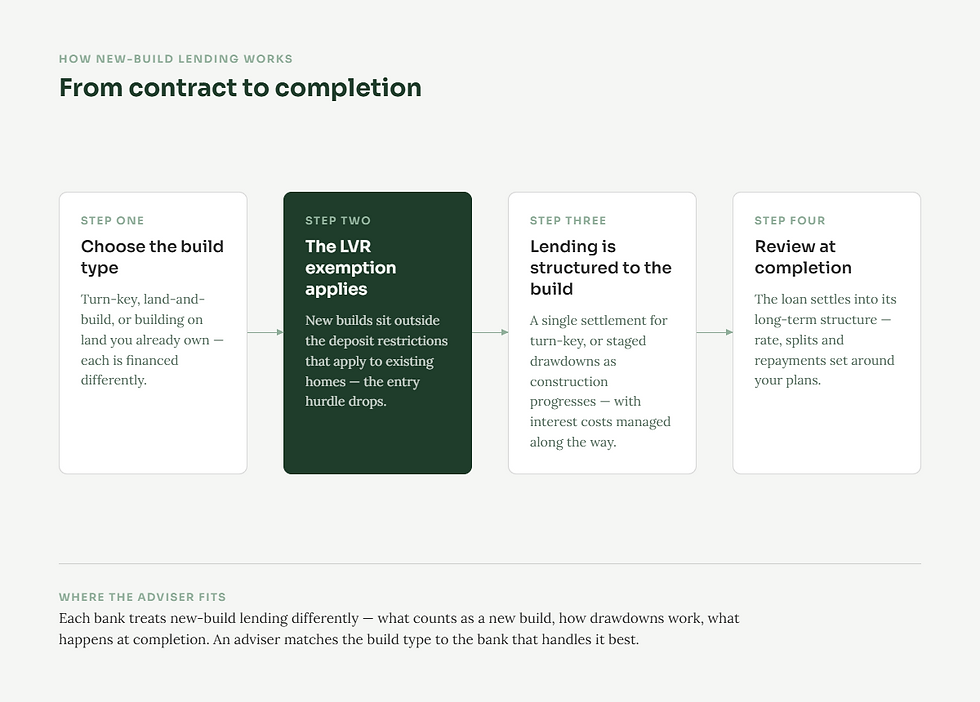
New builds sit outside this system entirely.
Lending for new construction is exempt from LVR restrictions.
No speed limits. No quota pressure.
That single exemption creates a structural advantage most buyers underestimate.
Existing Property: The Bottleneck
If you’re buying an existing property, you’re competing inside a constrained system.
Typical reality:
Owner-occupiers need ~20% deposit
Investors need ~30% deposit
Low-deposit lending is rationed by banks
Even when rules “ease,” the constraint doesn’t disappear. It just loosens slightly.
Banks still:
Prioritise first-home buyers for low-deposit slots
Apply internal overlays
Manage their LVR pipeline carefully
Result: access to leverage is inconsistent.
You can be declined not because you’re a bad deal, but because the bank is “full.”
That’s not a credit problem. It’s a policy problem.
New Builds: A Different Lending Environment
Now compare that to new builds.
Because they’re exempt:
Banks aren’t restricted by LVR quotas
Lower deposits are commonly accepted
Lending decisions become credit-based, not quota-based
In practice:
Owner-occupiers can often go above standard LVR thresholds
Investors can typically enter with materially less equity
Some deals land in the 10–20% deposit range depending on structure
That changes the game.
You’re no longer fighting for a slice of limited lending. You’re operating in a separate lane.
Why This Matters More in 2026
This isn’t just a technicality. It lines up directly with current market conditions.
We’re in a phase defined by:
Higher servicing sensitivity
Slower capital growth
Tighter borrowing capacity
Which means:
Cash is the limiting factor.
Every extra dollar tied up in deposits slows your ability to:
Enter the market
Scale a portfolio
Diversify lenders
New builds reduce that friction.
Example:
Two identical $700,000 properties:
Existing property: ~30% deposit = $210,000
New build: ~20% deposit = $140,000
That $70,000 difference is not small.
It’s:
Another deposit
A buffer
Or the difference between acting and waiting
The Portfolio Angle (Where It Actually Matters)
This is where most advice falls short.
People frame new builds as a “first home buyer advantage.”
That’s surface-level thinking.
The real advantage is portfolio velocity.
Lower deposit requirements mean:
Faster acquisition cycles
Less equity trapped per deal
More flexibility across lenders
And importantly:
New builds reduce cross-collateralisation pressure because you’re not stretching a single equity base as aggressively.
They also align better with how banks assess risk under modern frameworks, especially with DTIs now in play alongside LVRs.
The Trade-Off (Don’t Ignore This)
There’s a reason this arbitrage exists.
New builds aren’t automatically “better investments.”
You need to account for:
Build premiums
Slower short-term equity uplift
Developer quality risk
Yield variability depending on location
The LVR exemption is a financing advantage, not a guarantee of performance.
If you overpay or buy poor stock, the structure won’t save you.
But if you combine:
disciplined buying
realistic yield expectations
and a portfolio strategy
then the financing advantage becomes meaningful.

What Most Investors Get Wrong
They focus on:
price
interest rates
or trying to “time” the market
Instead of asking:
Where is the system giving me leverage?
Right now, that leverage sits in:
exemptions
policy gaps
and how banks are forced to behave
New builds sit at the intersection of all three.
Bottom Line
In a constrained lending environment, the best opportunities aren’t always the cheapest properties.
They’re the ones the system treats differently.
New builds:
bypass LVR speed limits
reduce deposit friction
and create scalability
That’s why they remain one of the cleanest entry points in 2026.
Not because they’re perfect.
Because the rules favour them.
If you’re trying to enter the market or structure your next purchase properly, the strategy matters more than the property.
The difference between one deal and a portfolio is usually how you finance it.
If you want a clear view on:
how much you can actually borrow
which lenders will back your structure
and whether a new build approach fits your position reach out.
Other relevant articles to check out:
About the Author:
Joshua Flack is a mortgage and lending adviser an
d the founder of Crisp Financial. Before finance, he spent two decades running businesses across construction, facilities services, and franchising, which is why his advice starts with how the numbers actually work rather than how the brochure says they should. He works with home buyers, investors, and self-employed borrowers across New Zealand, with particular depth in complex and non-standard lending. Crisp Financial Limited (FSP1012114) operates under the Link Financial Group FAP licence. The information in this article is general in nature and is not regulated financial advice.


Comments