
Non-Bank Lending in 2026: When It Makes Sense to Pay a Higher Rate

Updated: Jul 18
TL;DR
Non-bank and second-tier lenders charge more than the main banks. That's the trade-off. What you get is flexibility on the things the main banks won't bend on: tighter DTI, complex income, speed, and deals that don't fit the standard policy box. Used deliberately, with a clear exit back to a main bank, non-bank lending unlocks deals that would otherwise die. Used carelessly, it's just expensive debt. This post covers when the higher rate is worth it.
The main banks are rule-bound. You're either inside policy or you're not.
Non-bank lenders price risk instead of refusing it.
That difference is the entire value of non-bank lending. It's not cheaper. It's not meant to be. It's a tool for specific situations where the cost of the higher rate is less than the cost of not doing the deal.

What Non-Bank Lending Actually Is
Non-bank lenders, second-tier lenders, and peer-to-
peer platforms operate outside the main bank framework. They're not bound by the same Reserve Bank restrictions in the same way, so they have more flexibility on DTI, LVR and income assessment.
In exchange, they charge higher interest. Sometimes 1 to 3% above main bank rates, sometimes more, depending on the risk.
When the Higher Rate Makes Sense
You're outside main bank DTI.
If your debt-to-income ratio puts you in the exception bucket and the banks won't move, a non-bank lender may fund the deal. If the deal's return exceeds the rate premium, it can stack up.
Your income is complex.
Self-employed, recently changed structure, irregular income, the main banks struggle with anything non-standard. Non-bank lenders are more willing to assess the real picture.
Speed matters.
A deal with a tight settlement that a main bank can't process in time. A non-bank lender that can move in days can be the difference between securing and losing it.
The deal doesn't fit the box.
Unusual property, mixed use, or a situation the main banks just won't touch. Non-bank is the only path.

The Critical Rule: Have an Exit
Non-bank lending should almost always be a bridge, not a destination.
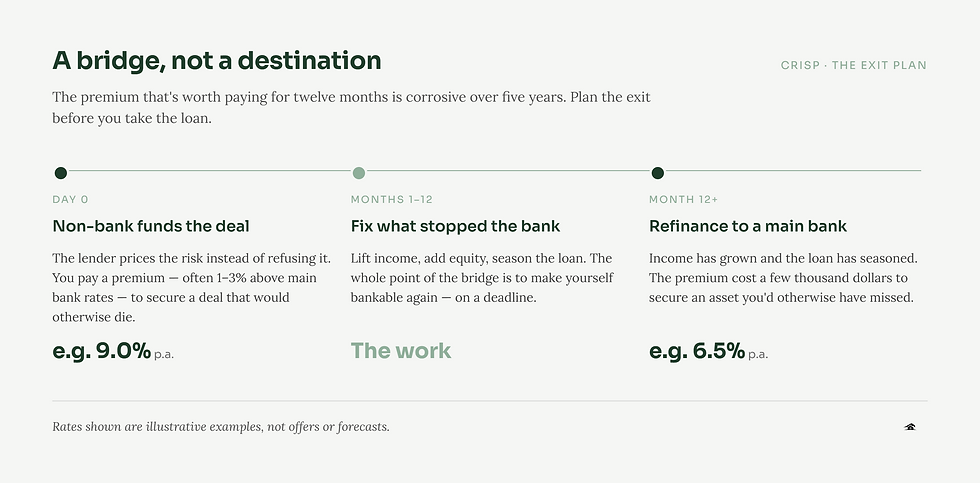
The plan should be: use non-bank finance to get the deal done, fix the issue that stopped the main bank (lift income, add equity, season the loan), then refinance to a main bank rate. Sitting on non-bank rates indefinitely erodes returns. The premium that's worth paying for 12 months is corrosive over five years.
Worked Example
Deal that returns 8% but your bank won't fund because of DTI. A non-bank lender funds it at 9%. On the surface, you're paying more than the deal returns.
But the deal also delivers capital growth and the rate is temporary. Twelve months later, your income has grown, the loan has seasoned, and you refinance to a main bank at 6.5%. The 12 months of premium cost a few thousand dollars to secure an asset you'd otherwise have missed entirely.
That's the calculation. Short-term premium against long-term ownership.
When It Doesn't Make Sense
No clear exit back to a main bank
The rate premium exceeds the deal's return with no growth to compensate
You're using non-bank to over-leverage past what's sensible
It's a patch over a structural problem you're not actually going to fix
If the answer to "how do I get out of this rate?" is "I don't know!," don't take the loan.
Where This Leaves You
Non-bank lending is a precision tool. It solves specific problems for a price. The price is worth it when the deal justifies it and you have a clear path back to cheaper money.
It's not a strategy for cheap. It's a strategy for access.
Knowing which non-bank lenders to use, and how to structure the exit, is exactly where an adviser earns their value. The main banks are the easy part.
At CRISP, we work across both main bank and non-bank lending. You'll get a straight read on whether a non-bank deal makes sense and how to get back to a main bank rate as fast as possible.
Access now. Cheaper later. Both planned from the start.
Relevant tools and resources available for free here:
Other relevant articles to check out:
The role of Bridging Finance
About the Author:
Joshua Flack is a mortgage and lending adviser and the founder of Crisp Financial. Before finance, he spent two decades running businesses across construction, facilities services, and franchising, which is why his advice starts with how the numbers actually work rather than how the brochure says they should. He works with home buyers, investors, and self-employed borrowers across New Zealand, with particular depth in complex and non-standard lending. Crisp Financial Limited (FSP1012114) operates under the Link Financial Group FAP licence. The information in this article is general in nature and is not regulated financial advice.


Comments