
The 3-Property Accelerator: A Roadmap for Moving from Homeowner to Investor


TL;DR
If you already own a home in New Zealand, you’re sitting on leverage most people underestimate. By using usable equity, structuring lending correctly, and avoiding common traps like cross-collateralisation, you can acquire three investment properties within five years without relying on savings alone. The key is sequencing. Start with a clean equity release, target lending-friendly assets like new builds, and spread lending across multiple banks. Policy, not income, is usually the constraint. This roadmap breaks the process into clear stages so you can move from one property to three with control, speed, and minimal friction.
Most homeowners assume the jump to investing requires years of saving. It doesn’t. The constraint is rarely cash. It’s structure.
In the current New Zealand environment, shaped by rules from the Reserve Bank of New Zealand, tax settings from Inland Revenue Department, and servicing pressure applied by lenders, the investors who move fastest are the ones who understand how the system actually works.
This is a five-year roadmap. It assumes you already own a home, have stable income, and at least moderate equity.
Step 1: Understand Your Starting Position (Months 0–3)
Before doing anything, you need clarity on three numbers:
Current property value
Existing mortgage balance
Servicing capacity under bank policy
Most people focus on equity. That’s only half the story. Servicing is what actually limits growth.
Banks don’t assess your borrowing at your current rate. They stress test at higher rates, often using guidance influenced by the Reserve Bank of New Zealand. That’s why someone with significant equity can still be capped.
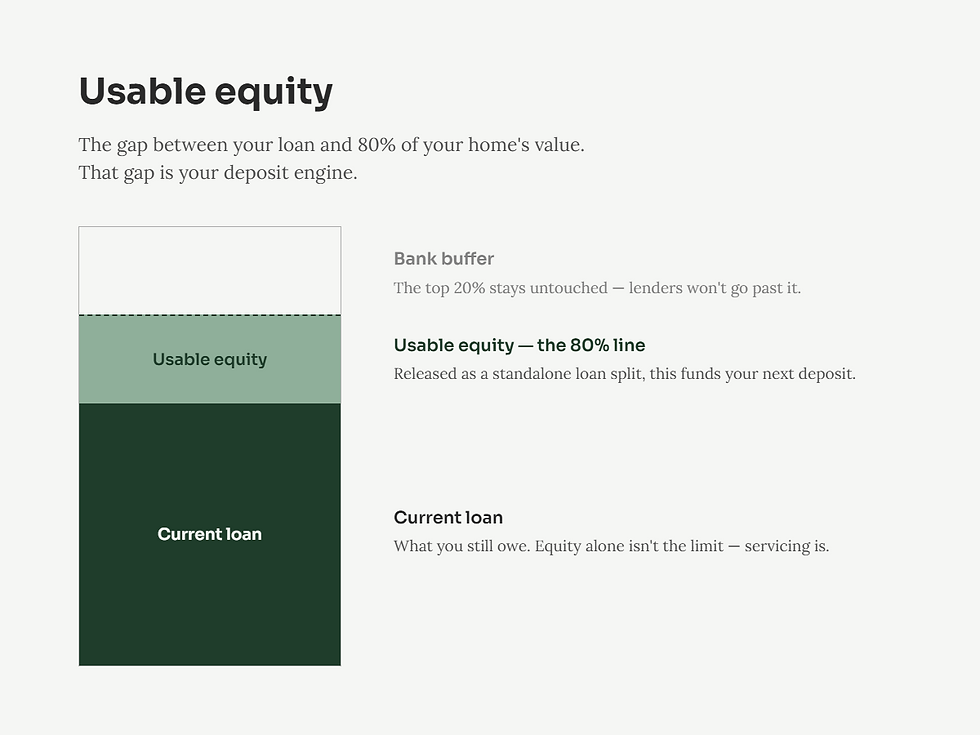
You’re looking for “usable equity.” That’s typically anything above 80% LVR.
Example in plain terms:
Home value: $1,000,000
Max lending at 80%: $800,000
Current loan: $600,000
Usable equity: $200,000
That $200k becomes your deposit engine.
The mistake here is going straight back to your existing bank and asking for “top-ups.” That leads to messy structures that slow you down later.
You want a separate, standalone equity release.
Step 2: Extract Equity Cleanly (Months 3–6)
This is where most investors either set themselves up properly or create problems they don’t understand yet.
The goal is simple. Pull out equity as a separate loan split secured against your home, but not tied to a specific new purchase.
This gives you flexibility.
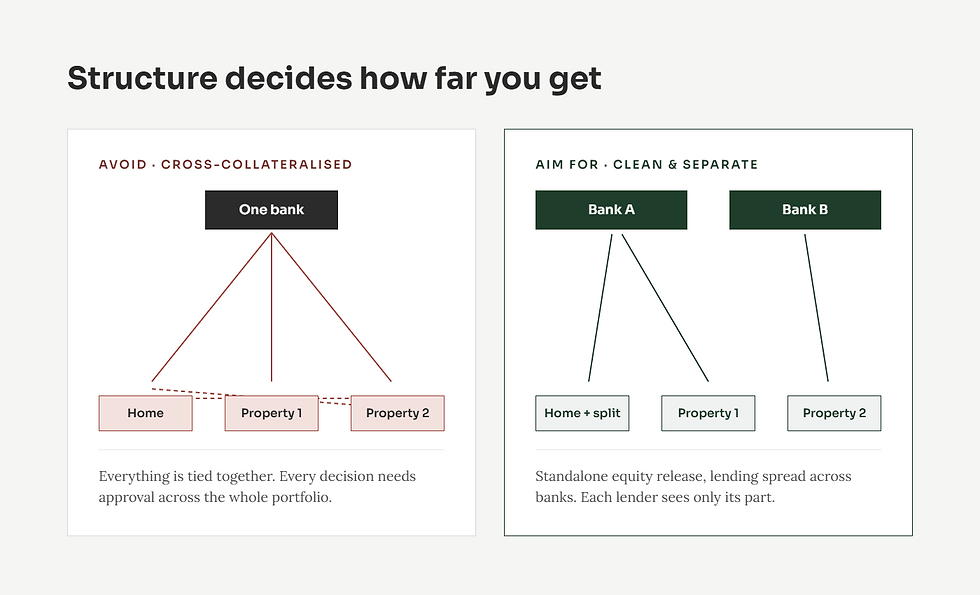
Poor structure looks like this:
One bank
Multiple properties tied together
No clear separation of lending purpose
That’s how people end up stuck.
Clean structure looks like this:
Standalone equity release
Clear split for deposit use
Ability to take that funding to another lender
This is where avoiding cross-collateralisation matters. Once properties are linked, every decision requires bank approval across the entire portfolio.
You want control.
Step 3: Buy Property One (Year 1)
Your first investment property should not be emotional. It should be strategic.
In the current environment, new builds often have an advantage due to LVR treatment. Policies influenced by the Reserve Bank of New Zealand allow more flexibility compared to existing stock.
That means:
Lower deposit requirements in some cases
Less competition from owner-occupiers
Cleaner lending approvals
You’re not chasing capital growth alone. You’re buying something that helps you move again. What matters:
Strong rental yield relative to price
Low maintenance
Bank-friendly valuation
At this stage, your focus is getting the first deal done without damaging your ability to get the second.
Step 4: Stabilise and Reset (Year 1–2)
Once the first property is settled, pause.
This isn’t about waiting. It’s about resetting your position.
Key moves here:
Lock in tenancy
Confirm actual rental income vs projected
Reassess servicing
Lenders like Westpac New Zealand and BNZ will treat real rental income differently from estimates. This can improve your borrowing position.
At the same time, property values may shift. Even small increases can create additional usable equity.
This stage is where disciplined investors pull ahead. Others rush and hit servicing walls.
Step 5: Buy Property Two (Year 2–3)
Property two is where structure matters more than ever.
You now have options:
Reuse equity from your home
Use uplift from property one
Combine both
But the bigger lever is lender diversification.
If your first deal was with one bank, the second should ideally be with another. This avoids concentration risk and keeps each lender assessing only part of your portfolio.
This is how experienced investors keep moving when others stall.
Property selection stays consistent:
New or near-new stock
Solid yield
Conservative assumptions
You’re building a system, not chasing a win.

Step 6: Optimise Tax Position (Ongoing)
You can’t ignore tax. It directly affects cash flow.
The phased return of interest deductibility rules under Inland Revenue Department changes the equation, particularly for existing properties versus new builds.
At a high level:
New builds tend to retain more favourable treatment
Older stock can have reduced deductibility depending on timing
This impacts:
Net yield
Holding costs
Borrowing capacity
If you don’t model this properly, you’ll think a deal works when it doesn’t.
Step 7: Buy Property Three (Year 3–5)
By the time you reach property three, the constraint is almost always servicing, not equity.
You’ve already extracted most available leverage. Now it’s about:
Income strength
Rental performance
Existing debt structure
This is where earlier decisions show up.
If you:
Cross-collateralised
Stayed with one lender
Overextended on low-yield properties
You’ll struggle here.
If you:
Kept lending clean
Diversified banks
Focused on cash flow
You’ll still have room to move.
Property three doesn’t need to be bigger or better. It just needs to fit.
What Typically Goes Wrong
Most people don’t fail because the strategy is flawed. They fail because they make predictable mistakes.
Common ones:
Using one bank for everything - Feels easier. Kills flexibility.
Buying based on emotion - Location preference over numbers.
Ignoring servicing early - Assuming equity is enough.
Messy loan structures - Especially revolving credit misuse.
Waiting too long between purchases - Letting momentum stall.
These aren’t technical errors. They’re discipline issues.

The Real Constraint: Policy, Not Ambition
You can have strong income, good equity, and still get stuck.
Why?
Because lending is policy-driven.
Every bank applies its own rules, shaped by regulatory settings from the Reserve Bank of New Zealand, but interpreted differently.
That creates opportunity.
The same borrower can get:
Declined by one lender
Approved by another
That’s why structure and sequencing matter more than most people realise.
A Simple Timeline
Here’s what this looks like in practice:
Year 1
Extract equity
Buy property one
Year 2
Stabilise
Reassess servicing
Year 3
Buy property two
Year 4
Optimise structure and tax
Year 5
Buy property three
Not aggressive. Not passive. Controlled.
Final Point
This approach isn’t about getting rich quickly. It’s about building a base.
Three well-structured properties put you in a different category. From there, options expand.
But if you get the first three wrong, fixing it later is slow and expensive.
If you already own a home and want to understand what your “three-property path” actually looks like, get it mapped properly before making a move.
At Crisp, we don’t just tell you what you can borrow. We show you how to structure it so you can borrow again.
Start with a clear plan. Everything else follows.
Relevant tools and resources available for free here:
Other relevant articles to check out:
Refinance for Equity Release
About the Author:
Joshua Flack is a mortgage and lending adviser and the founder of Crisp Financial. Before finance, he spent two decades running businesses across construction, facilities services, and franchising, which is why his advice starts with how the numbers actually work rather than how the brochure says they should. He works with home buyers, investors, and self-employed borrowers across New Zealand, with particular depth in complex and non-standard lending. Crisp Financial Limited (FSP1012114) operates under the Link Financial Group FAP licence. The information in this article is general in nature and is not regulated financial advice.


Comments