
Interest-Only vs. Principal-and-Interest: The Cash Flow Battle
- Joshua Flack
- Apr 12
- 4 min read

TL;DR
In a high-rate, modest-growth market, structure matters more than ever. Interest-only (IO) lending wins on short-term cash flow, often improving holding costs by hundreds per month and reducing negative gearing pressure. Principal-and-interest (P&I) wins on long-term wealth, steadily reducing debt and interest exposure. The data shows IO can cut weekly holding costs significantly, but increases total interest paid and leaves you exposed to refinancing risk. In 2026, the “best” structure isn’t universal. If your strategy is yield, portfolio growth, and flexibility, IO often fits. If your goal is debt reduction and certainty, P&I is the safer path. Most investors should use both deliberately.

The context: why this decision matters more in 2026
The market has shifted. Debt is expensive. Capital growth is subdued. Yields have improved, but not enough to hide poor structure.
That changes the question.
It’s no longer “which loan is cheaper? ”It’s “which structure keeps you in the game long enough to win?”
Because right now, cash flow determines survival.
What the numbers say: IO vs P&I in practice
Let’s anchor this in reality.
A typical example from current NZ lending:
$700,000 loan at ~4.5–6%
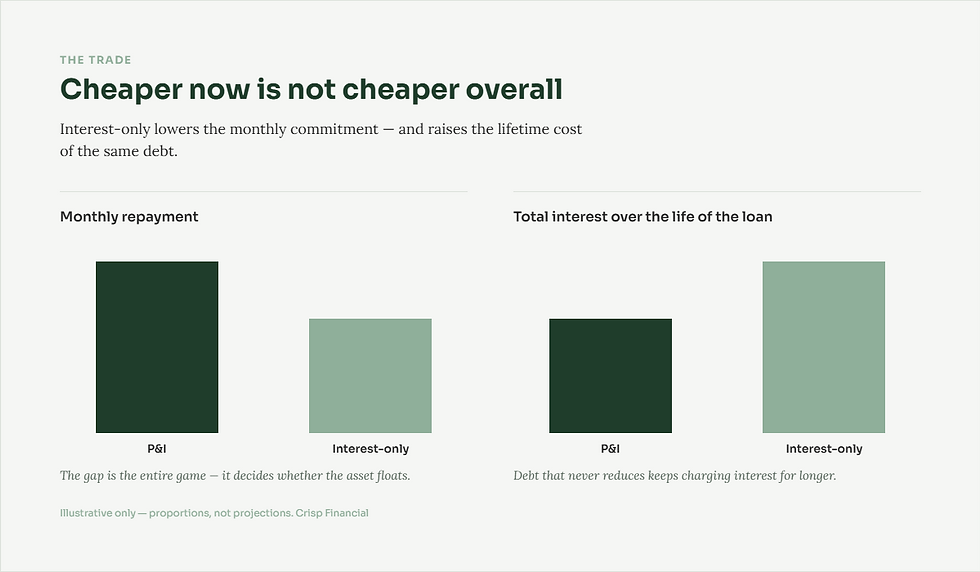
P&I repayment: ~ $3,600/month
Interest-only repayment: ~ $2,600/month
That’s roughly $1,000 per month difference.
On a rental:
P&I structure: often -$200 to -$300/week
IO structure: closer to -$50/week
That gap is the entire game.
One structure forces you to subsidise heavily.The other keeps the asset afloat.
Interest-only: the cash flow operator
IO loans are simple. You pay interest. The debt doesn’t reduce.
That’s exactly why investors use them.

What the data shows:
Lower repayments improve serviceability and portfolio scalability
Rental income is more likely to cover costs
Interest remains tax-deductible for investors in NZ
In practical terms:
You preserve cash
You reduce weekly holding costs
You buy time
This matters in a flat market. If growth is muted, you’re not being paid to carry a loss.
IO lets you hold assets without bleeding.
That’s why most portfolio investors lean this way early.
The trade-off: IO is not “cheaper”
It just feels cheaper.
Because:
You’re not reducing debt
You pay interest for longer
Total borrowing cost increases over time
A simple outcome:
5 years IO = lower payments now
But higher lifetime interest cost later
You’re effectively choosing:
Short-term survival
vs
Long-term efficiency
There’s also a structural risk.
At the end of the IO term:
repayments jump
refinancing is not guaranteed
lending criteria may tighten
If you can’t refinance or convert, you may be forced to sell.
That risk is often ignored.
Principal-and-interest: the long game
P&I is slower, but cleaner.
Every payment:
reduces debt
lowers future interest
builds equity
It’s forced discipline.
Banks prefer it for a reason.
What it does well:
De-risks over time
Improves equity position regardless of market
Removes reliance on refinancing
If the market goes sideways for 5–10 years, P&I investors still move forward.
IO investors don’t.
The real comparison: cash flow vs control
Strip it back.
Factor | Interest-Only | Principal & Interest |
Monthly cash flow | Strong | Weak |
Portfolio scalability | High | Limited |
Debt reduction | None | Consistent |
Total interest paid | Higher | Lower |
Risk at reset/refinance | Higher | Lower |
Flexibility | High | Low |
That’s the trade.
2026 reality: yield is back, but not enough
Here’s the mistake most investors make right now.
They assume higher yields fix everything.
They don’t.
Even with improved rents:
P&I still creates negative cash flow in many cases
IO often moves deals closer to neutral
That difference determines whether you can:
buy another property
hold through rate cycles
survive shocks
Structure isn’t a detail. It’s strategy.
When IO is the right move
IO works best when:
You’re in growth or accumulation phase
You want to maximise borrowing capacity
You’re managing multiple properties
Cash flow is tight or uncertain
You plan to recycle or restructure debt later
In short:
You’re playing offence.
When P&I makes more sense
P&I is better when:
You’re nearing retirement
You want certainty and simplicity
You’re holding fewer properties
You prioritise debt reduction over expansion
You don’t want refinancing risk
You’re playing defence.
The hybrid strategy (what experienced investors actually do)
This is where most people get it wrong.
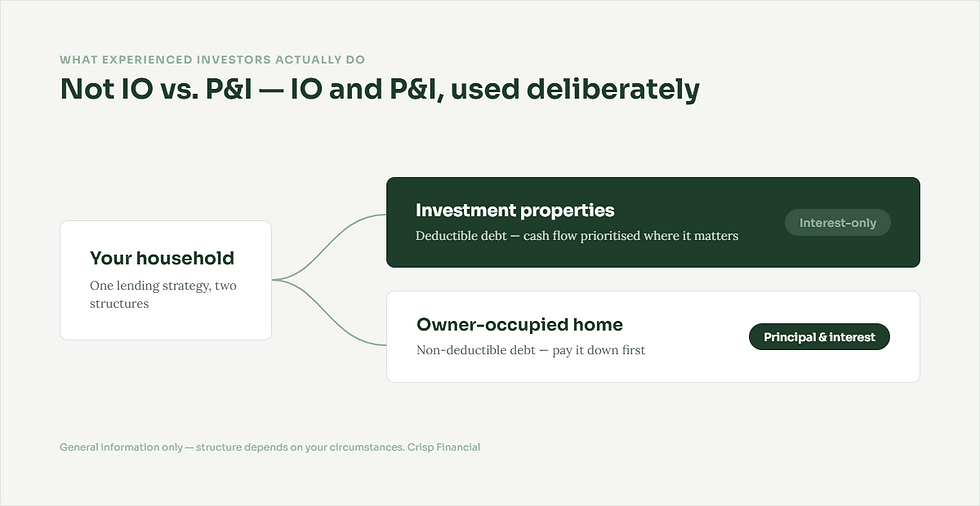
It’s not IO vs P&I.
It’s IO and P&I, used deliberately.
A common structure:
Investment properties → Interest-only
Owner-occupied home → Principal & interest
Why?
Investment debt is typically tax-deductible
Personal debt is not
Cash flow is prioritised where it matters
This approach:
improves overall household position
accelerates net worth
keeps flexibility
It’s not theory. It’s how portfolios scale.
The real risk in 2026
It’s not choosing IO.
It’s choosing IO without a plan.
Problems show up when:
investors assume growth will bail them out
they don’t prepare for P&I rollovers
they rely on refinancing in tighter credit conditions
We’ve seen this before.
If values stall or drop, IO magnifies risk because equity doesn’t move.

Bottom line
IO is a cash flow tool
P&I is a debt reduction tool
Neither is “better”.
But in a high-rate, modest-growth environment:
IO often keeps deals viable
P&I often kills scalability
The right answer depends on your phase, not your preference.
If you’re not actively choosing your loan structure, you’re leaving performance on the table.
At Crisp, we design lending structures around outcomes, not products. That means aligning cash flow, tax position, and long-term strategy from day one.
If you want a clear view on how your current or next deal should be structured, get in touch. We’ll map it properly before you commit.
Relevant tools and resources available for free here:
Other relevant articles to check out:
About the Author:
Joshua Flack is a mortgage and lending adviser and the founder of Crisp Financial. Before finance, he spent two decades running businesses across construction, facilities services, and franchising, which is why his advice starts with how the numbers actually work rather than how the brochure says they should. He works with home buyers, investors, and self-employed borrowers across New Zealand, with particular depth in complex and non-standard lending. Crisp Financial Limited (FSP1012114) operates under the Link Financial Group FAP licence. The information in this article is general in nature and is not regulated financial advice.


Comments