
The Christchurch Industrial Boom: Can Residential Investors Get a Piece of the Action?


TL;DR
Christchurch has quietly become one of the strongest markets in the country, driven by affordability, rebuilt infrastructure, and an industrial and logistics sector that's pulling in jobs and people. For residential investors, the question is how to benefit from that economic strength without becoming a commercial property expert. This post looks at the Christchurch story and the residential angles that ride the same wave.
Christchurch spent a decade being defined by what happened to it. Now it's being defined by what's being built.
The city's industrial and logistics sector has been a genuine growth engine. New infrastructure, relative affordability, and land availability have drawn business and people. Economic strength in a region eventually shows up in residential demand, and that's the opportunity for investors who aren't commercial specialists.
Why Christchurch Is Performing
A few things came together:
Affordability relative to Auckland and even Wellington, drawing internal migration
Modern, rebuilt infrastructure following the rebuild
Industrial and logistics growth creating employment
Land availability that keeps development viable
Strong local employment is the foundation of residential demand. Where the jobs go, the tenants follow.

The Residential Angle
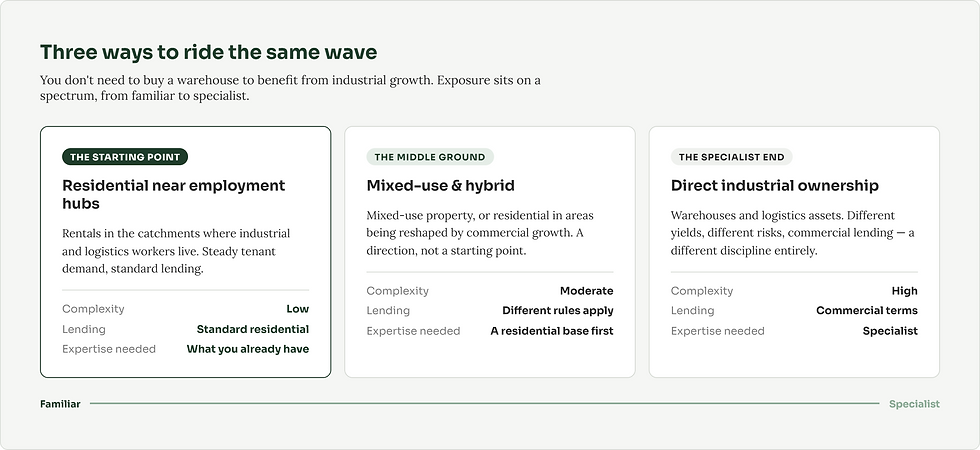
You don't need to buy a warehouse to benefit from industrial growth. The residential plays that ride the same economic wave:
Rental property near employment hubs. Industrial and logistics jobs need workers, and workers need housing close to where they work. Residential rentals in those catchments benefit from steady tenant demand.
Affordable entry with real yield. Christchurch's relative affordability means the yield maths often works better than the bigger metros, important in a high-rate environment.
New build supply that's actually absorbed. Unlike some oversupplied Auckland corridors, Christchurch's growth has been more matched to demand in many areas.
The Commercial-Residential Hybrid
For investors wanting more direct exposure, there's a middle ground. Mixed-use properties, or residential in areas being reshaped by commercial growth, sit between the two worlds.
This is more complex. Lending is different, yields and risks differ, and it needs more expertise. It's not a starting point, but it's a direction for investors who've built a residential base and want to diversify toward the economic strength driving the region.
The Risk
Regional booms can run ahead of fundamentals. The questions to ask:
Is the employment growth durable or cyclical?
Is residential supply keeping pace, getting ahead, or falling behind?
Am I buying into the strength, or buying after it's already priced in?
Buying a regional growth story late, after the easy gains are gone, is a common mistake.
Where This Leaves You
Christchurch's economic strength is real and it supports residential demand. You can benefit through straightforward residential investment in the right catchments, without becoming a commercial expert.
Buy near the employment, check the supply, and don't pay tomorrow's price for today's fundamentals.
Regional investing means understanding both the local market and how the banks view lending in that region. Some lenders treat regional stock differently.
At CRISP, we help investors target regional opportunities with lending structured for the specific market. The Christchurch story is real, but the deal still has to fund.

Other relevant articles to check out:
About the Author:
Joshua Flack is a mortgage and lending adviser and the founder of Crisp Financial. Before finance, he spent two decades running businesses across construction, facilities services, and franchising, which is why his advice starts with how the numbers actually work rather than how the brochure says they should. He works with home buyers, investors, and self-employed borrowers across New Zealand, with particular depth in complex and non-standard lending. Crisp Financial Limited (FSP1012114) operates under the Link Financial Group FAP licence. The information in this article is general in nature and is not regulated financial advice.



Comments