
Population Outflows and the Housing Market: Should You Worry About New Zealanders Moving to Australia?

TL;DR
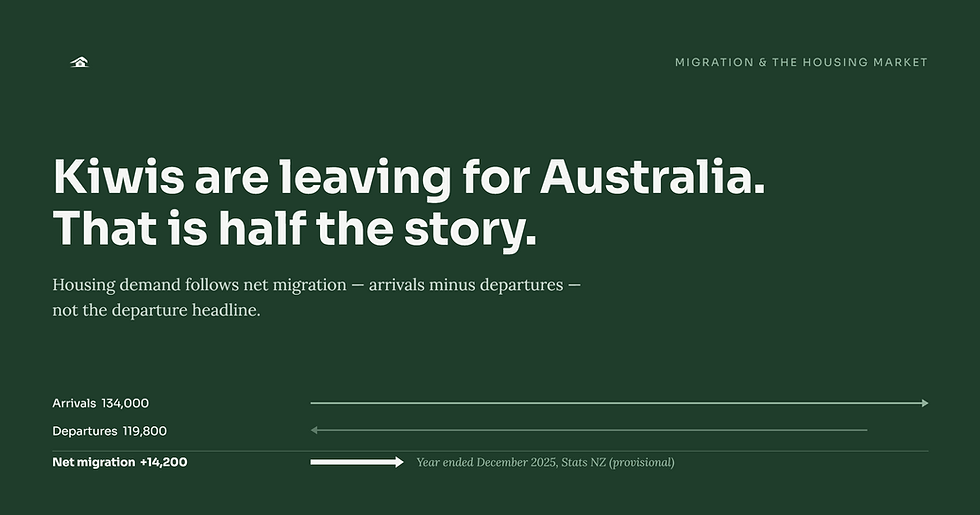
Headlines about Kiwis leaving for Australia spook investors. The reality is more nuanced. Net migration is the number that matters, not just departures, and arrivals have historically offset much of the outflow. This post looks at what the migration data actually says, who's leaving versus who's arriving, and what the real impact on rental demand is.
The "Kiwis fleeing to Australia" story is a reliable headline generator.
It's also incomplete. Departures are only half the equation. The number that actually drives housing demand is net migration, arrivals minus departures, and that picture is more complicated than the headline suggests.
Departures Are Only Half the Story
Yes, New Zealanders leave for Australia, particularly when the Australian economy and wages are running hot. That's a real and recurring pattern.
But people also arrive. New Zealand has historically attracted migrants, returning citizens, and workers on various visas. The net figure, what's left after subtracting departures from arrivals, is what changes housing demand.
Focusing only on departures is like looking at a company's costs and ignoring its revenue.

What the Net Figure Tells You
When net migration is positive, the population is growing, and growing population needs housing. Even when departures are high, strong arrivals can keep the net positive.
The composition matters too. Departing Kiwis are often younger, sometimes renters, sometimes leaving shared housing. Arrivals often need to rent immediately on arrival, frequently adding net rental demand even when the population maths looks flat.
The Rental Demand Angle
Here's the part investors miss. Migration affects the rental market faster and more directly than the ownership market.
New arrivals rent first. They don't buy on arrival. So periods of strong arrivals feed rental demand quickly, supporting rents, before they ever show up in house prices.
Departures, meanwhile, often remove people from the rental pool (shared housing, younger renters) rather than from the ownership market. The net effect on rental demand is frequently less negative than the departure headline implies.

What Actually Threatens Demand
The real risks to housing demand aren't a single year of high departures. They're sustained, structural shifts:
A prolonged period where departures dramatically exceed arrivals
A collapse in the arrival drivers (visa settings, economic appeal)
Regional outflows where a local economy loses its employment base
A single alarming departure figure in isolation isn't the signal. The trend in the net figure over time is.

Where This Leaves You
Don't make investment decisions off departure headlines. Look at net migration, look at the trend, and remember that arrivals hit the rental market fast.
If net migration is positive, the structural demand for housing is intact regardless of how many Kiwis are posting about Bondi. If it turns sustainedly negative, that's a genuine signal worth acting on. The headline alone isn't.
Demand fundamentals underpin every long-term investment thesis. Getting the read right matters more than reacting to any single month's news.
At CRISP, we ground lending decisions in the durable drivers, not the noise. Migration is one input. We help you weigh it properly.
Other relevant articles to check out:
About the Author:
Joshua Flack is a mortgage and lending adviser and the founder of Crisp Financial. Before finance, he spent two decades running businesses across construction, facilities services, and franchising, which is why his advice starts with how the numbers actually work rather than how the brochure says they should. He works with home buyers, investors, and self-employed borrowers across New Zealand, with particular depth in complex and non-standard lending. Crisp Financial Limited (FSP1012114) operates under the Link Financial Group FAP licence. The information in this article is general in nature and is not regulated financial advice.


Comments