
How Lenders Assess Self-Employed Income in New Zealand

TL;DR
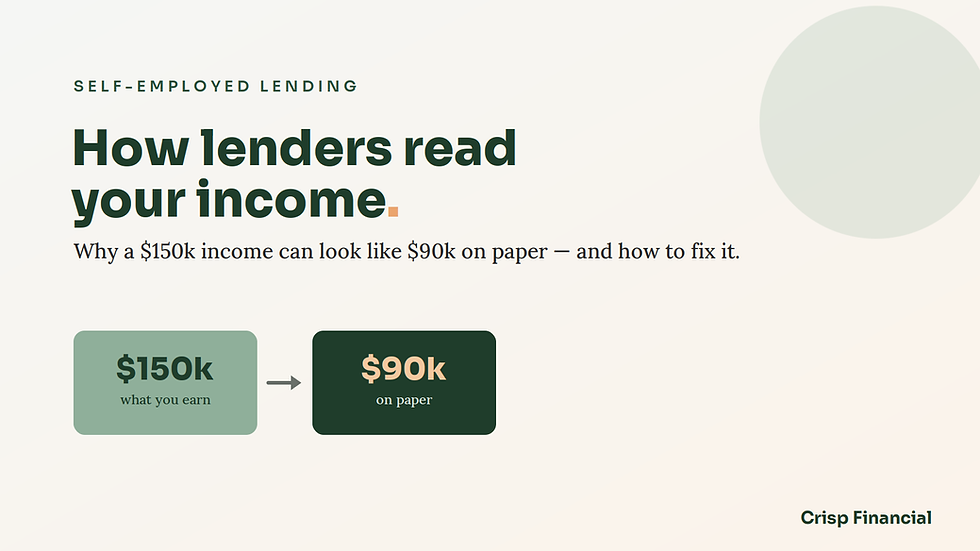
If you're self-employed, lenders don't look at your revenue or what you draw from the business. They start with the net profit in your finalised financial statements, cross-checked against your IRD records, then adjust it. The catch is that the same accounting discipline that keeps your tax bill down also makes your income look smaller to a bank, so a contractor really earning $150,000 can appear to earn $90,000 on paper. Add-backs recover some of that, but different lenders apply them differently, which means the same financials can produce assessable incomes tens of thousands of dollars apart depending on which bank is reading them.
Self-employed borrowers get a raw deal from a lending system built for salaried people.
A salaried applicant hands over three payslips and an income summary, and the bank knows what they earn. Simple. For the self-employed, the bank goes digging through your financials, and the number they land on often looks nothing like what you actually earn.
Understanding how they get to that number is the difference between an approval and a frustrating, avoidable decline.
Where Lenders Start: Net Profit, Not Revenue or Drawings
Two things lenders don't use: your top-line revenue, and what you pay or draw from the business.
What they use is the net profit in your finalised business financial statements, the profit after all expenses, cross-checked against your IRD records to confirm it's real. If you trade through a company, they'll look at the company result alongside any shareholder salary you pay yourself. Drawings don't count as income.
Most main banks (ANZ, ASB, BNZ, Westpac, Kiwibank) want two full years of finalised financial statements as their default, along with the matching IRD assessments and recent business bank statements. That's the mechanical answer, and it's where most explanations stop. It's also not the part that catches people out.
The Trap: Good Tax Planning Makes You Look Poorer
Here's the problem at the heart of self-employed lending.
Your accountant's job is to legitimately minimise your taxable income. Depreciation, home office costs, shareholder salary structuring, and legitimate business expenses all reduce the profit you pay tax on. That's exactly what you want at tax time.
But the bank reads that reduced profit figure at face value. So the same discipline that saves you tax makes your income look smaller to a lender. A contractor genuinely earning $150,000 can appear to earn $90,000 on paper. A business owner on $200,000 can look like they're barely covering costs.
Your accountant did the right thing. The bank is reading the numbers as written. Neither is wrong. But the gap between them is real, and it's what sinks applications that shouldn't fail.
How Add-Backs Recover Some of the Gap
This is where add-backs come in. Lenders will add certain expenses back onto your net profit, because those expenses don't actually reduce the cash you have available to service a loan.
The common ones:
Depreciation. A non-cash expense, so it gets added back. You claimed it for tax, but you didn't actually spend that money this year.
Home office costs. Often added back, since it's a portion of expenses you'd have anyway.
Shareholder salary. If you trade through a company and pay yourself a shareholder salary, that can be added back and included in your income.
One-off costs. Genuine one-time expenses that won't recur can sometimes be added back.
Add-backs move your assessable income closer to what you actually earn. But, and this is the crucial part, not every lender treats them the same way.

Why the Same Financials Get Different Answers
This is the single most useful thing to understand about self-employed lending.
Lenders differ on the fundamentals of how they assess you. Some use your most recent year. Some average the two years. Some use the lower of the two years, to be conservative. And they differ on which add-backs they'll allow and how far they'll go.
Put those variables together and the same set of financial statements can produce an assessable income that differs by $30,000 to $50,000 depending on which lender is doing the calculation. On the same accounts.
That difference can be the gap between approved and declined. Which means a decline from one bank isn't a verdict on your business. It's a statement about that bank's method. Another lender, reading the identical financials with a different approach, may say yes comfortably.
What This Means in Practice
A few things follow from all of this.
First, presentation matters. How your financials are packaged and explained, the story behind the numbers, business stability, the reason for any one-off dip, materially affects the outcome. A well-presented application is not the same application as a pile of statements handed over without context.
Second, lender choice is not a detail. For a self-employed borrower it may be the whole game. Matching your specific financial picture to the lender whose method reads it most favourably is exactly the value an adviser adds.
Third, don't let a single decline convince you that you can't borrow. If your business is genuinely profitable and one bank's method made it look marginal, that's a lender-fit problem, not a you problem.

Where This Leaves You
Self-employed income assessment is more art than arithmetic, and the arithmetic is unforgiving of the wrong lender. Lenders start from net profit, adjust with add-backs, and differ enough in their methods that the same accounts can swing tens of thousands of dollars in assessable income.
The takeaway isn't to change how your accountant handles your tax. It's to understand that the tax-efficient picture and the lending picture are different, and to get your application in front of a lender whose method actually reflects what you earn.
The gap between how your accountant presents your income and how a lender reads it is where self-employed applications live or die. Knowing which lenders assess self-employed income most favourably, and how to package the case, is specialist work.
At Crisp we translate real business income into the strongest possible lending position, and match it to the lender most likely to see your business the way you do. Profitable businesses shouldn't get declined on a technicality.
Relevant tools and resources available for free here:
Other relevant articles to check out:
About the Author:
Joshua Flack is a mortgage and lending adviser and the founder of Crisp Financial. Before finance, he spent two decades running businesses across construction, facilities services, and franchising, which is why his advice starts with how the numbers actually work rather than how the brochure says they should. He works with home buyers, investors, and self-employed borrowers across New Zealand, with particular depth in complex and non-standard lending. Crisp Financial Limited (FSP1012114) operates under the Link Financial Group FAP licence. The information in this article is general in nature and is not regulated financial advice.


Comments