
Escaping the “One Bank Trap”: Why Diversification is the Key to Unlocking Your Next Loan

TL;DR
Relying on a single bank limits your borrowing power, flexibility, and long-term strategy. Most people don’t realise their structure quietly locks them into one lender through cross-collateralisation. That makes it harder to access equity, negotiate terms, or get future deals approved. Diversifying across multiple lenders gives you control. It isolates risk, improves servicing options, and keeps each property working independently. If you’ve built equity but feel stuck, your structure is likely the issue, not your income. The right lending setup doesn’t just get one deal done. It sets you up to keep moving.

Most borrowers don’t hit a wall because they’ve run out of income or equity. They hit a wall because of how their lending is structured.
The “one bank trap” is exactly what it sounds like. You’ve got all your lending sitting with one lender, often tied together across multiple properties. It usually starts out of convenience. One approval leads to another. The bank encourages it. The process feels simple.
Then you try to move again and realise you’re stuck.
This isn’t a niche problem. It’s the default outcome for most borrowers who haven’t had someone actively structuring their lending with a long-term view.
If your goal is to build a property portfolio or simply keep your options open, diversification across lenders isn’t a nice-to-have. It’s foundational.
What actually is the “one bank trap”?
At a surface level, it looks like loyalty. You’ve got a relationship with your bank. They know you. You’ve done multiple loans with them.
Underneath, it’s control.
When all your lending sits with one bank, they control your entire position. That includes your existing loans, your usable equity, and your ability to move forward. Every new deal is assessed in the context of your full exposure with that lender.
That’s where things tighten.
Banks don’t assess risk property by property. They assess it at a portfolio level when everything is tied together. If one part of your position changes, it can affect everything else.
That’s fine when things are simple. It becomes a problem as soon as you want to scale.
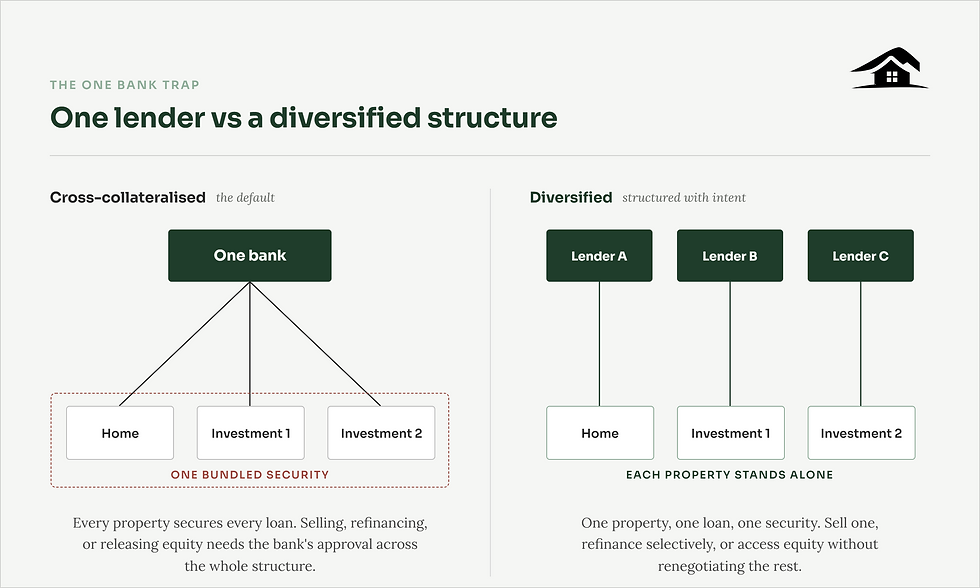
The role of cross-collateralisation
Cross-collateralisation is the mechanism that creates the trap.
It happens when a bank uses multiple properties as security across multiple loans, linking them together. Instead of each property standing on its own, they’re bundled.
It’s often presented as efficient. One set of documents. One approval. Less paperwork.
The trade-off is control.
When properties are cross-collateralised, you lose the ability to make independent decisions. Selling one property requires the bank’s approval across the whole structure. Accessing equity becomes a negotiation, not a right.
More importantly, it limits your ability to use different lenders.
No other bank can step in cleanly because the securities are intertwined.
You’re effectively locked in.
Why banks encourage it
From the bank’s perspective, cross-collateralisation reduces their risk.
They’ve got multiple assets securing their exposure. If one property underperforms, they’ve got others to lean on. It also makes it harder for you to refinance away from them.
That’s not malicious. It’s just aligned with their incentives, not yours.
Your goal is flexibility and growth. Their goal is security and retention.
Those two don’t always overlap.
What this looks like in practice
A common scenario.
You own a home worth $1.2m with a $600k mortgage. You’ve built solid equity. You go back to your bank to buy an investment property.
They approve the deal but structure it by tying both properties together. Your new loan is secured against both your home and the investment.
It feels straightforward. You move on.
A few years later, you want to buy again. Or sell the investment and upgrade your home.
Now the bank reassesses everything. They may restrict how much equity you can release. They may require proceeds from a sale to reduce other loans. They may decline the new deal entirely based on their internal exposure limits.
At that point, your options are limited.
You can’t easily move one property to another lender because it’s tied into the broader structure. Unwinding it can be complex, time-consuming, and sometimes not possible without triggering costs or revaluations that work against you.
That’s the trap.
What diversification actually means
Diversification isn’t about spreading loans randomly across multiple banks.
It’s about structuring each purchase so it stands on its own.
Each property should have its own loan, secured against that property alone wherever possible. Equity is accessed cleanly, often via a separate facility, and then deployed without tying securities together.
This creates separation.
Separation gives you control.
When each property is independent, you can:
Sell one without impacting the others
Refinance selectively
Access equity without renegotiating your entire portfolio
Work with different lenders based on their strengths
It turns your lending into a system rather than a collection of transactions.
Why this matters for your next loan
Most people think the next deal is about servicing.
In reality, structure is often the limiting factor.
Different lenders assess income, expenses, and risk in different ways. What one bank declines, another may accept comfortably. If you’re tied to a single lender, you’re stuck with their view of your position.
Diversification gives you access to multiple credit policies.
That matters more as your portfolio grows. Small differences in how lenders treat rental income, existing debt, or living expenses can materially change your borrowing capacity.
It also gives you negotiating leverage. You’re not dependent on one bank’s terms or turnaround times.

The compounding effect over time
The impact of structure isn’t obvious after one deal.
It shows up over three, four, five moves.
A well-structured portfolio compounds flexibility. Each property adds options rather than constraints.
A poorly structured one compounds friction. Each new loan makes the next one harder.
This is why two borrowers with similar incomes and equity can end up in completely different positions within a few years.
One can keep moving. The other stalls.
Why most people don’t fix it early
There are three main reasons.
First, it’s not visible. You don’t feel the problem until you try to do something new.
Second, it’s not prioritised. The focus is usually on getting the current deal done, not setting up the next three.
Third, it requires intent. Proper structuring takes more upfront work. It’s not the path of least resistance.
Banks won’t push for it because it doesn’t serve their interests. Many brokers don’t push for it because it adds complexity.
So it gets missed.
Unwinding the one bank trap
If you’re already in it, you’re not stuck forever.
But it does require a deliberate approach.
The starting point is understanding your current structure in detail. Which loans are tied together, how securities are allocated, and where the pressure points are.
From there, it’s about identifying opportunities to separate properties over time. That might involve refinancing, revaluations, or restructuring facilities.
It’s rarely a single-step fix.
But even partial separation can materially improve your position.
What to do differently going forward
Every new purchase is a chance to get the structure right.
That means:
Avoiding cross-collateralisation wherever possible
Keeping securities separate
Using equity releases strategically rather than bundling
Selecting lenders based on long-term fit, not just immediate approval
This doesn’t mean overcomplicating things.
It means being intentional.
The Crisp perspective
The people this matters most to are not first-home buyers.
It’s those who’ve built meaningful equity and are starting to think about what comes next. At that point, decisions carry more weight. The structure behind your lending becomes just as important as the properties themselves.
Speed stops being the priority. Control does.
The goal isn’t to get one deal approved.
It’s to build a position that allows you to keep moving without hitting artificial limits.
If you’ve built equity but your progress has stalled, there’s a high chance your structure is the issue.
We review your current lending, identify where you’re constrained, and map out a structure that gives you room to move again.
No assumptions. No shortcuts.
Just a clear plan based on how lenders actually assess your position.
If that’s where you’re at, get in touch with Crisp.
Relevant tools and resources available for free here:
Other relevant articles to check out:
About the Author:
Joshua Flack is a mortgage and lending adviser and the founder of Crisp Financial. Before finance, he spent two decades running businesses across construction, facilities services, and franchising, which is why his advice starts with how the numbers actually work rather than how the brochure says they should. He works with home buyers, investors, and self-employed borrowers across New Zealand, with particular depth in complex and non-standard lending. Crisp Financial Limited (FSP1012114) operates under the Link Financial Group FAP licence. The information in this article is general in nature and is not regulated financial advice.


Comments